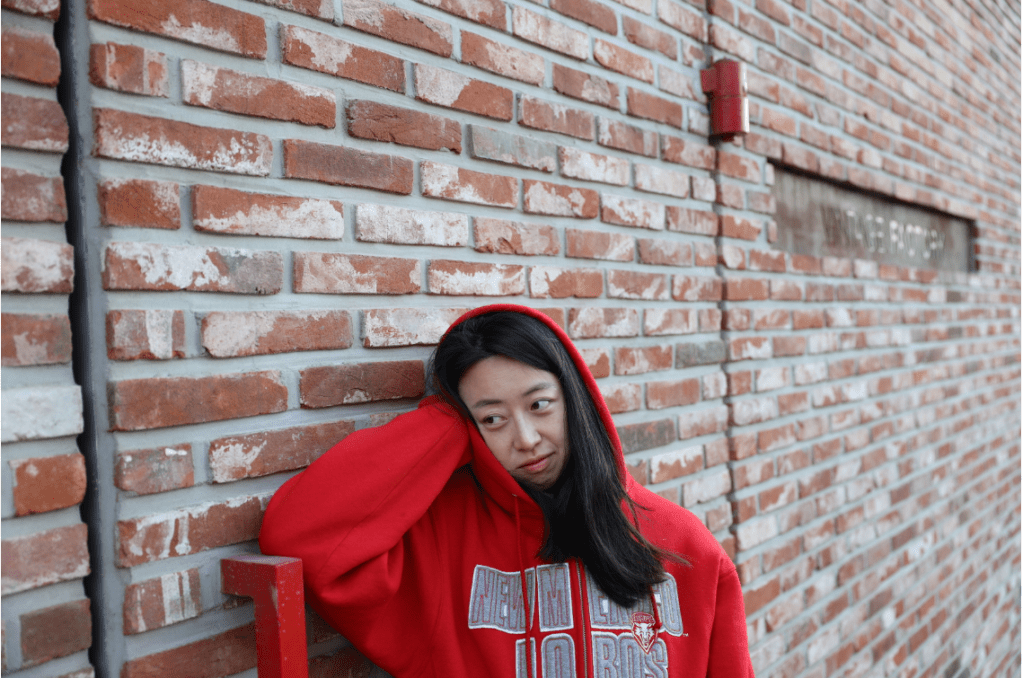
Yesul Kim
Yesul Kim (b. 1991, South Korea) is a sound artist nurturing a symbiosis between generative algorithms, embodied listening, and spatial design.
Based in Finland since 2023, her dual background in music and architecture converges into an ‘architecture of the invisible’ — sound as a medium that constructs space, memory, and somatic agency through acoustic field recordings, voice, and generative recomposition.
Instead of composing linear music, she builds “sound columns,” “acoustic beams,” and “resonant voids.” This was evident in her early collaborative works such as Perception Medium (2022) and Posture Regression Poiesis (2023), where she used sound to alter the viewer’s perception of physical space, creating environments where geometry seemed to breathe.
While utilizing Max/MSP algorithms to organize her sound material, her sonic palette consists entirely of organic timbres: field recordings of geological formations, the resonance of the human voice, and textures of traditional Korean music.
Rather than used for sound synthesis, the algorithm functions as a “digital wind”—an underlying force that scatters, layers, and reassembles acoustic particles into new sonic fabrics, constantly evolving in time, structural density and space, turning recorded matter into a living, inhabitable score.
Her installations are most often realised as immersive 5.1 surround environments, where spatial placement and movement become compositional material.
Kim’s recent work has turned inward and downward, exploring themes of heritage, migration, and the maternal body. In her solo exhibition Sound Space: Pansori (2024), she deconstructed the traditional Korean opera Sugungga, using algorithms to fragment the narrative into a non-linear, dreamlike underwater palace. This practice of “sonic decomposition” parallels her ongoing research in Finland, where she investigates the geological acoustics of the Salpausselkä ridges.
Currently, Kim’s work is focused on two major strands: Geological Somatics, exploring the relationship between soil vibration and the human nervous system (Rooting / Subterranean Lullaby), and Organic Interfaces, researching how children can interact with technology through voice and body rather than screens (ChildEye).
Ultimately, Kim’s practice frames the algorithm not as a replacement for human intuition, but as a shelter for it. In an era where digital interfaces increasingly demand passivity, she constructs ‘warm technologies’—responsive sonic environments that require deep listening and physical presence. Her work offers a defense of somatic agency, proposing that in the post-digital age, the most radical act is to remain grounded in the body.
Kim holds degrees in Music and Architecture. Her work has been supported by the Arts Promotion Centre Finland (Taike), Incheon Cultural Foundation and the Seoul Foundation for Arts and Culture, among others. She lives and works in Central Finland, where she raises her two children in a quiet landscape of forests, lakes and sand ridges —a terrain that has become the silent co-author of her latest work.

